
When Intelligence Becomes Abundant,
Judgment Becomes the Constraint
Decision Architecture • Judgment | 2 may 2026
Decisions now outrun verification.
Signal is reshaped before it reaches authority.
Judgment is executed on compromised reality that no longer holds.
Decisions in large organisations are increasingly being made faster than they can be understood.
What happens when institutions built for stability—or optimised for scale—are forced to operate at the level of judgment, coherence, and truth, without the internal capacity to do so?
The Compression of Decision-Making
As artificial intelligence moves from experimentation into core decision processes, it compresses the distance between information, decision and action.
Signals now form continuously. The structures responsible for interpreting them remain layered, periodic and slow.
For decades, organisational decision-making followed a stable sequence. Information was gathered, filtered through hierarchy, interpreted, and escalated to authority. Incentives, reporting lines and committees were designed to align this process over time.
The lag between signal and decision was a feature. It allowed for verification, dissent and accountability to take shape. It also prioritised institutional equilibrium—and, in doing so, defined how organisations absorbed risk.
Acceleration alters this sequence.
First, signals form and move faster, leaving little room for staged interpretation. Decisions that once unfolded over weeks now demand resolution in days or hours. In liquid markets, even short-lived signals – policy remarks, positioning statements, or model-driven flags- can force near-immediate repositioning.
Second, organizations are embedding model-driven outputs into decisions faster than governance frameworks can adapt. The issue is not technological adoption, but interpretive capacity. Signals are continuous. Validation remains periodic.
Third, the architecture of accountability does not move at the same speed. Reporting lines, committee cycles, and incentive structures remain anchored in a slower cadence.
The result is a widening gap between how quickly risk forms and how slowly it can be seen, interpreted and acted upon.
In that gap, decision quality does not simply degrade. It becomes structurally distorted.
For boards and executive teams, this is no longer a technical issue. It is a question of whether the organisation can still see clearly what it is deciding on.
The implications are already visible in areas such as private markets, where underwriting, monitoring and valuation are increasingly informed by faster-moving data and model-driven insights. Frameworks built for periodic assessment are now asked to absorb continuous signal.
The risk is not only that decisions are wrong, but that institutions lose the ability to know whether the signal informing them was intact.
When Signal Integrity Breaks Down
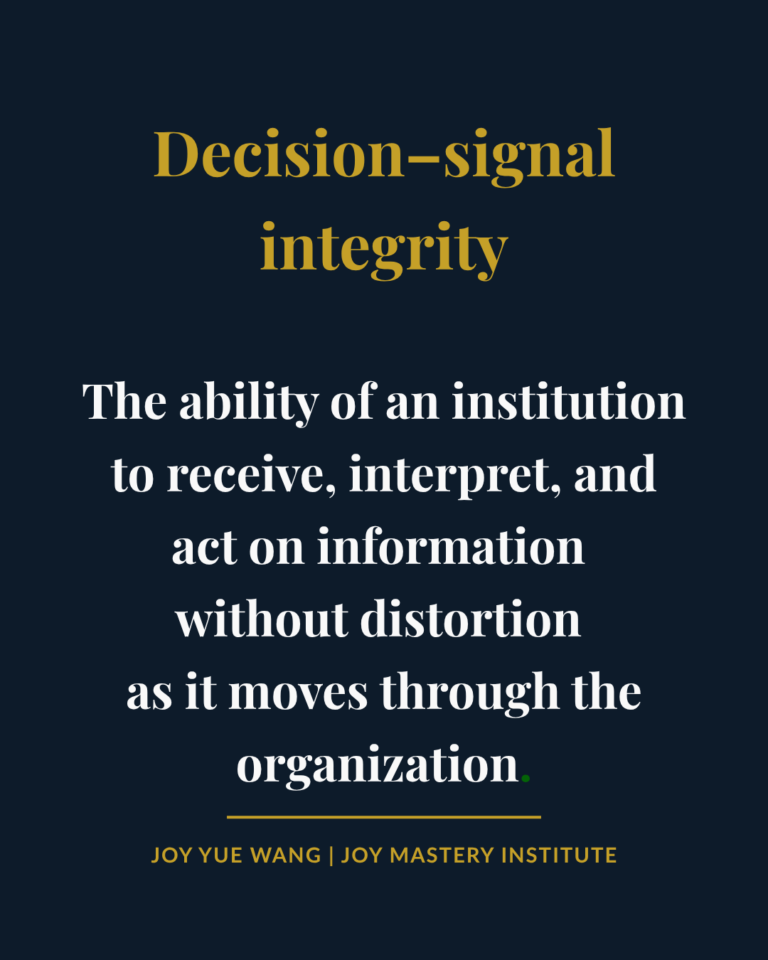
What appears as an abundance of intelligence is, in practice, a degradation of decision–signal integrity—the ability of an organization to receive, interpret and act on information without it being filtered, delayed or reshaped by the structure through which it moves.
Under acceleration, signals do not simply travel faster. They are more likely to be truncated, amplified or selectively framed as they pass through layers that were not designed to process them at speed.
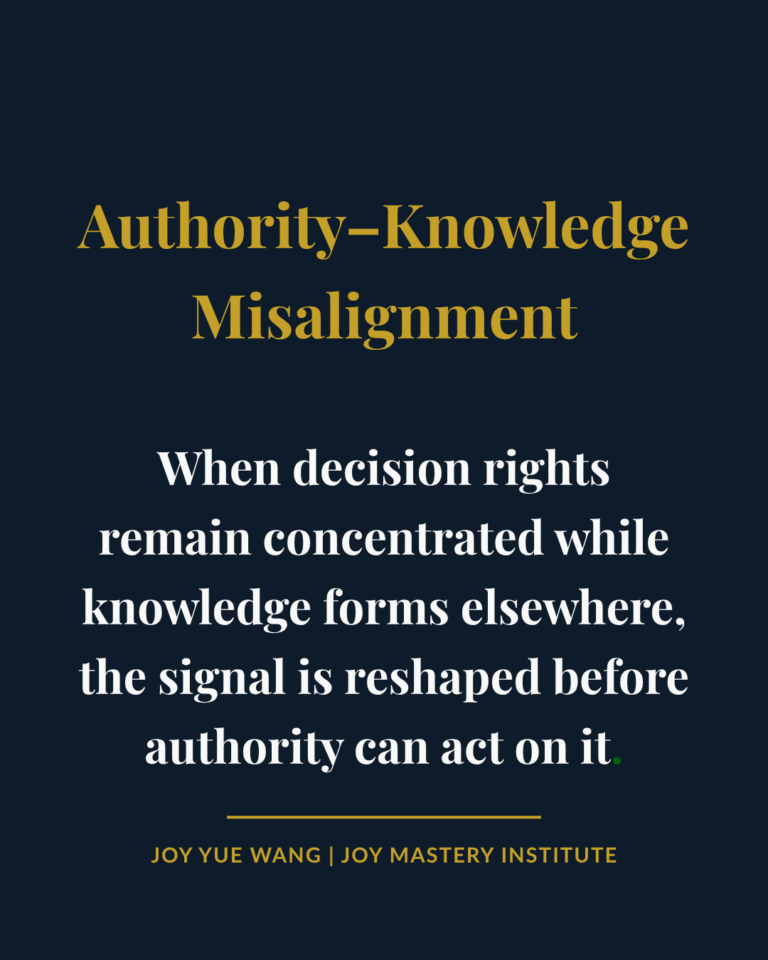
Authority compounds the problem. In most institutions, decision rights remain concentrated at the top, while knowledge is generated closer to the edge. This is not inherently flawed.
The distortion emerges in the layers in between.
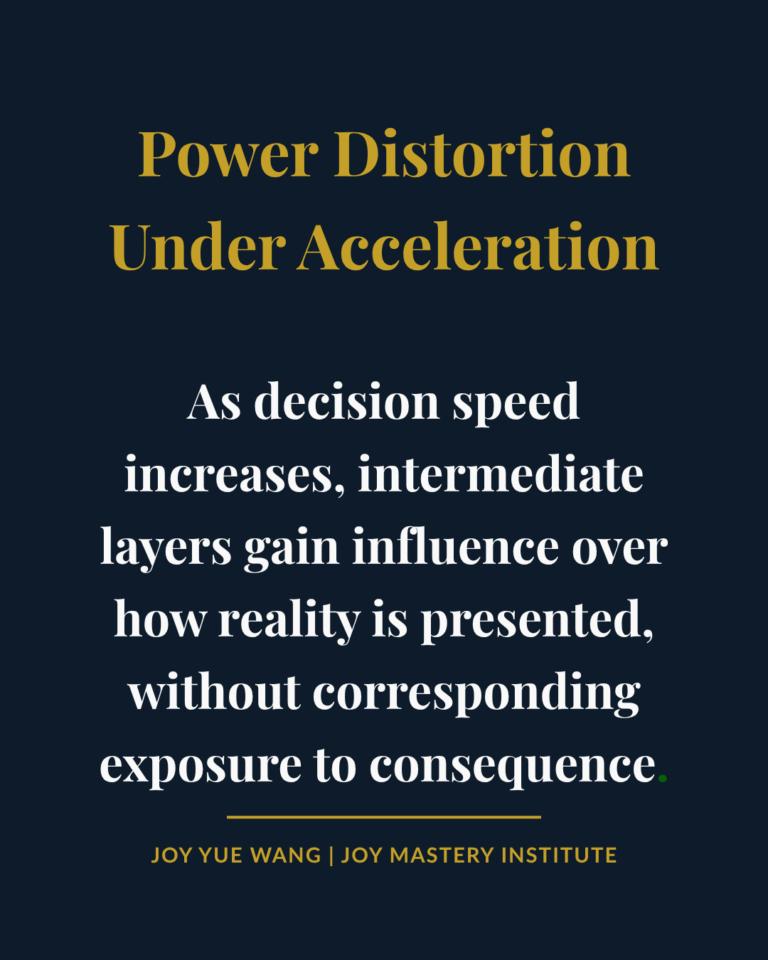
Intermediate layers increasingly function as translators of signal rather than originators of judgment—shaping how information travels upward while remaining insulated from direct exposure to consequence.
Under stable conditions, this separation can be managed. Under acceleration, it becomes a source of authority–knowledge misalignment.
Those closest to emerging signals often lack the authority to act. Those with authority receive a version of the signal that has already been shaped by incentives, hierarchy and time.
This is where power distortion under acceleration begins to take hold.
Information is filtered upward to align with internal metrics. Uncertainty is translated into narratives that travel across committees. Accountability becomes diffuse as decisions are made on compressed timelines but evaluated on lagging outcomes. What reaches the top is not the signal itself, but a negotiated interpretation of it.
Within complex organizations, language serves a dual function: to describe reality and to preserve perceived competence. In highly managed environments, the second function tends to expand. Risk is reframed as nuance. Uncertainty becomes “evolving conditions.” Over time, this does not simply soften communication—it alters what is cognitively registered as signal.
What cannot be named precisely cannot be acted on clearly.
When intelligence and tools become abundant, it is tempting to interpret this moment as an elevation—from routine execution to higher-order decision-making. In practice, the hierarchy is shifting in a different way. Access to intelligence is becoming abundant. The capacity to interpret it coherently is not.
Governance Under Acceleration
The constraint has moved.
Historically, institutions competed on access—information, capital, and tools. These formed the operational foundation.
Judgment under ambiguity sat above this layer. It mattered, but intermittently—at moments of allocation, crisis, or strategic inflection.
Under acceleration, this structure no longer holds.
Access is no longer scarce. Information is abundant, capital is mobile, and tools are increasingly available.
What differentiates outcomes is not access, but the capacity to interpret and act with coherence under continuous signal flow.
The hierarchy has inverted. Judgment—once episodic— now determines whether decisions hold at all.
This is not a marginal adjustment. It requires a re-examination of how authority is structured and exercised.
Information architecture becomes a governance issue. Boards and executive teams can no longer treat data and analytics as technical infrastructure. They must ask whether the path from signal generation to decision preserves integrity—or introduces systematic distortion.
Decision rights must be reconsidered. Where speed is critical, the issue is not whether authority is centralised or decentralised. It is whether authority is receiving an intact signal.
In many institutions, it is not.
Authority is separated from knowledge not by design intent, but by the accumulation of intermediate translation—where signal is reshaped without exposure to consequence.
Incentives must be recalibrated. When performance is measured on short-term outputs while downside is absorbed collectively, information will continue to be reshaped before it reaches decision-makers.
Organizations must confront a more difficult question: whether their institutional coherence can still hold under conditions that no longer allow for delay. Processes designed to create consensus may, under acceleration, obscure divergence. Structures designed to ensure accountability may, under speed, disperse it.
These are not questions about technology adoption. They are questions about whether an institution can still produce judgment when the environment no longer accommodates the pace at which its governance operates.
The risk is not that machines will make decisions.
It is that institutions will continue to make decisions without being able to see clearly what they are deciding on.
This dynamic is not confined to corporates. It is visible in any system where decision authority and signal interpretation are structurally separated.
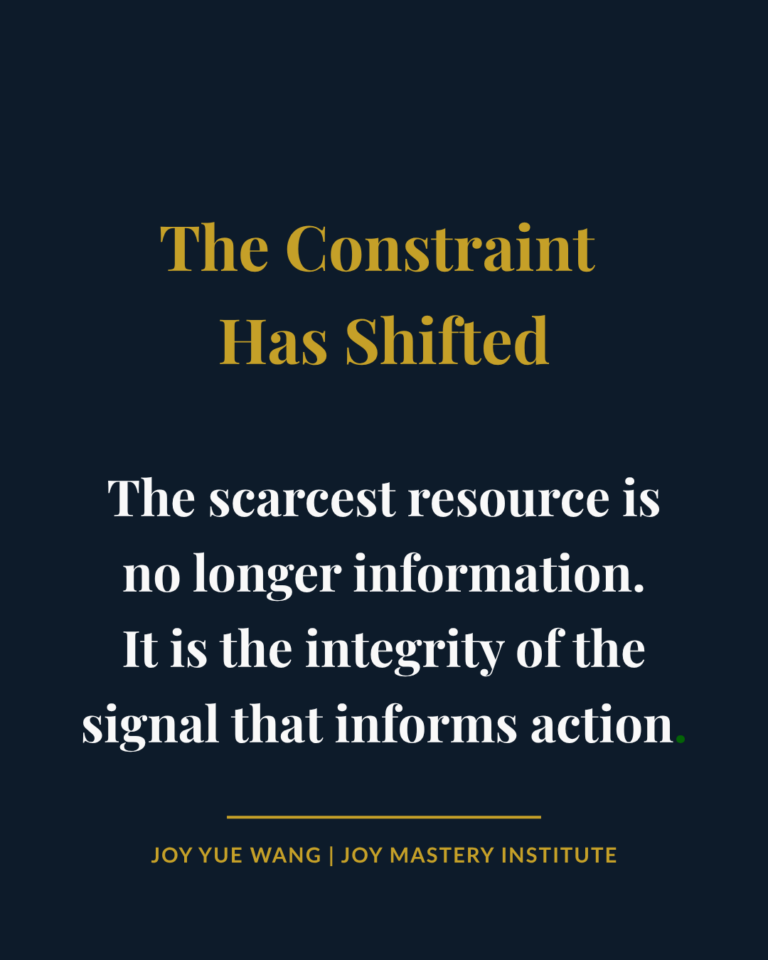
In an environment where intelligence is abundant, the scarcest resource is no longer information.
It is the integrity of the signal that informs action.
For boards and C-suites, this is no longer a technical question.
It is a governance one—and increasingly, a source of material risk.
© 2026 Joy Yue Wang. All rights reserved.